
Developmental resilience
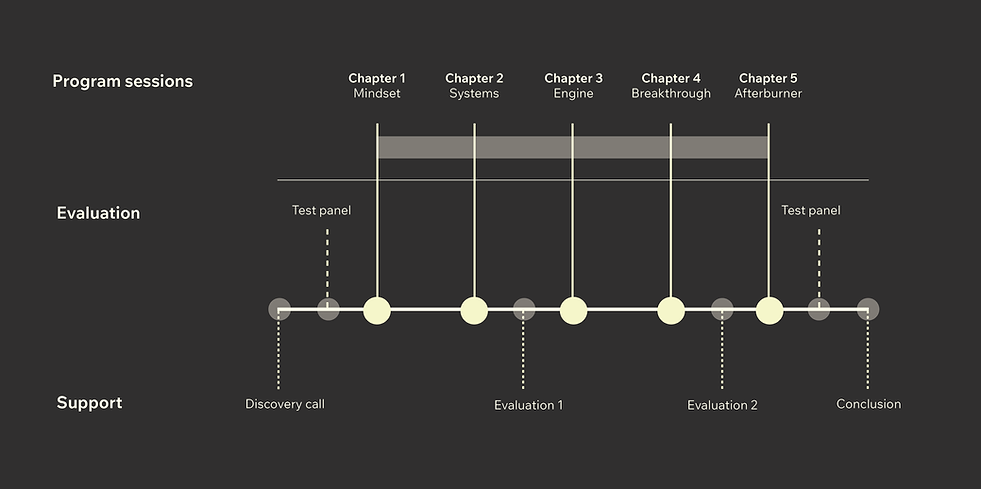
Program syllabus
Introduction
Definition
Developmental resilience is a personal transformation program which entails access to exclusive online content and being partnered with a transformation consultant in order to systematically increase your resilience and mental strength.
Born out of a need to replace transient motivation and low willpower with an actionable program that effectively works.
The program connects empirical research from clinical psychology, literature and popular science into structured, personalized protocols which are aimed at helping people dismantle their mental blocks, counterproductive habits, limiting beliefs and corrosive notions of what high-output performance looks like.
Through one-on-one consulting, content modules, practical exercises and evaluative tools, it functions as a comprehensive syllabus engineered to help ambitious individuals learn about grit and its usage in navigating pivotal life transitions and reclaiming high-level energy levels in proffesional life.
It drives a transformation between personal stagnation and a sustainable, high-output performance that prevents burnout and increases meaningful output, all the while the participant might find something that is even more elusive: meaning.
Program outline
Chapter | Subtitle | Description |
|---|---|---|
Start of program | ||
Mindset | Introduction | Before you take a single step, you must change how you perceive the path. This module is dedicated to destroying the "fixed mindset", the belief that talent, intelligence, and physical limits are static. |
Primary resources | Mindset by Carol Dweck, Man’s Search for Meaning by Viktor Frankl and The Expectation Effect by David Robson. | |
Summary | Dweck’s research provides the objective proof that the brain is plastic and that effort itself is what creates capability. We anchor this to Frankl’s case study on extreme resilience, specifically his ability to maintain a positive, defiant internal state regardless of external circumstances. Robson in turn, provides the mechanical proof: your expectations act as a biochemical self-fulfillment prophecy. | |
Scientific backing | Neural Correlates of Growth Mindset: A Scoping Review of Brain-Based Evidence (Hang Zeng) |
Module excerpts
The following texts are excerpts of the five modules the student covers while going through the Developmental Resilience program.
Module 1: Mindset
Introduction
Carol S. Dweck is an American psychologist, she currently holds the Lewis and Virginia Eaton Professorship of Psychology at Stanford University. Her research centers on the transformative power of how individuals perceive their own capabilities, distinguishing between a fixed mindset and a growth mindset.
What is relevant from Dweck's work for the Mental Resistance Lab is how a simple concept that at face value would seem to be only relevant to the science of learning, ends up relating to an incredible amount of inter-disciplinary concepts of all sorts: from self-talk to self-worth to the ego, as well as emotional responses, communicative skills and much more.
Fixed mindset
Those with a fixed mindset believe that traits are static, leading to a desire to possess desirable ones such as being smart, sophisticated, talented or "perfect". People with this mindset develop a tendency to avoid challenges given that they might put that self-image at risk, therefore trapping themselves into boxes of their own making.
The person with the fixed mindset tends to catastrophize failures and is prone to quickly label themselves and others as insufficient, quickly pointing out the recurrent culprit: static personality traits and characteristics i.e. "I am such an idiot".
Dweck reveals that the fixed mindset, far from being a mere personality trait, functions as a sophisticated, rigid defense mechanism. It is a belief that your fundamental qualities, your intelligence, your talent, and your very character are carved in stone. This core conviction breeds an urgency to prove yourself over and over. If you possess only a predetermined, finalized quantity of intelligence or ability, then every situation becomes a high-stakes forced-choice test on that immutable self.
"Believing that your qualities are carved in stone (the fixed mindset) creates an urgency to prove yourself over and over" Carol S. Dweck.
This constant, internal judgment creates an excruciating pressure, compelling individuals to seek instant excuses, to avoid difficulty and to protect their ego from the perceived judgment of inadequacy, in other words, to confront a task in which one might struggle, is to invite the dreaded verdict of "not good enough". In that instant, the mind, in a semi-panic state to protect this static identity from judgment, generates instant excuses. These aren’t logical deductions; they are preemptive defensive strikes; "I was tired", "It wasn't fair", "I didn't really care anyway"; these are the mind's shields, thrown instantaneously to divert the perceived threat away from the immutable self-image. This defensive architecture, constantly validating its pre-ordained limits, creates a self-imposed ceiling, suffocating potential before it even has a chance to breathe.
Module 2: Systems
Summary: This module focuses on the mechanical transition from conscious effort to subconscious execution. Fogg’s Model establishes the physics of behavior for a habit to fire: motivation, ability, and a prompt must converge.
We then use Clear’s framework to increase ability by reducing friction and designing an environment that triggers the prompt automatically. This operationalizes Graybiel’s research on "Action Chunking," moving the daily grind from the expensive Prefrontal Cortex into the efficient Basal Ganglia. You automate the "how" so the brain doesn't waste willpower on basic execution.
Introduction
The Fogg Behavior model as described in the paper "A Behavior Model for Persuasive Design" is an attempt at understanding human behavior. It operates as an elegant mechanism of human psychology, asserting that any given action occurs only when motivation, ability, and a trigger converge and act together in a mechanistic balance.
With insights into into persuasive design; it models how behavior change can be automated and the fundamental elements to achieve the behavior activation threshold, which is when a person performs a behavior.
"The Fogg Behavior Model (FBM) asserts that for a person to perform a target behavior, he or she must (1) be sufficiently motivated, (2) have the ability to perform the behavior, and (3) be triggered to perform the behavior. These three factors must occur at the same moment, else the behavior will not happen." Brian Jeffrey Fogg
B.J. Fogg strips away the guesswork and vagueness of human behavior (and its unpredictability) by mapping its components onto a conceptual plane in which a combination of these three factors will approach or surpass a limit called the behavior activation threshold. If an individual falls below the behavioral activation threshold, no amount of prompting will yield results.
It must be noted that a a deficiency in one factor (motivation, ability, trigger) does not automatically mean all others will be nullified, if an individual possesses exceptionally low motivation yet still perform a target behavior if the task requires virtually zero effort, meaning their ability is exceptionally high.
Under the Fogg Behavior Model, simplicity can effectively compensate for a lack of desire, for example, a person may have no active interest or motivation to purchase a brand-new vehicle, but if a legitimate seller offers them that car for a single dollar (1 USD), the behavior will occur. Because the financial ability required is so negligible, the behavior easily clears the activation threshold the moment a prompt occurs (trigger), despite the baseline absence of motivation.
Module 3: Grit
Introduction
Angela Duckworth defines grit as the combination of two distinct traits: passion and perseverance. Passion is the first half of the equation, providing the long-term direction and enduring interest in a specific top-level goal. Perseverance constitutes the second half, serving as the active psychological force that sustains effort over that extended duration.
Chapter 1: Showing up
Angela opens her analysis by examining the rigorous environment of the United States Military Academy at West Point, specifically focusing on the grueling initial training period known as Beast Barracks. She observes that the admissions process relies heavily on the Whole Candidate Score, a comprehensive metric encompassing standardized test scores, high school rank, leadership potential, and physical fitness.
Despite the exhaustive nature of this evaluation, the military found that this score was entirely ineffective at predicting which cadets would successfully endure the intense physical and psychological pressures of Beast Barracks and which would drop out. This discrepancy prompted the realization that an unmeasured variable was determining success in this highly demanding environment.
To identify this missing variable, Duckworth developed a psychological questionnaire designed to measure a specific combination of unyielding passion and relentless perseverance. She administered this assessment to incoming cadets and discovered that the individuals who scored the highest on this new metric were overwhelmingly the ones most likely to complete Beast Barracks. She named this crucial psychological trait "grit," defining it not as a momentary burst of intense effort, but as a sustained, long-term commitment to a singular goal despite encountering significant obstacles.
Module 4: Breakthrough
Introduction
The book Can't hurt me by David Goggins is an account on the vicissitudes of one person's life, the arduous path, the exhausting cycle of endless hardships and the turnaround where the author decided he was not going to walk the path that destiny set for him.
It is fiercely written, it does not talk about popular topics like the military, mental grit and sport performance from a trite, all too common, banal lens of scientific data; all the opposite, it is a magnificent story that uses breaking performance ceilings as a catalyst on the often dormant potential of an average person, leaving a burning mark of the sublime aspects of the human spirit.
In order to illustrate the story the author details every step of the struggle in chronological order; its message resonates because the author is vulnerable enough to point out the incredibly traumatic events in childhood and early adulthood perpetrated by his father's malfeasance and his mother's absence; most astoundingly, and to our benefit, he vividly recounts the mechanisms created by his brain in order to hardwire an attitude of complete accountability and the impossibility of quitting.
His story illustrates that one is not determined by his/her past, in other words, if one is brave enough to take one's personal demons out in the open, one can choose their impact and their meaning. What he found is that if channeled correctly, one can use the awful aspects of life to pry open an endless reservoir of energy and drive, and to get an answer that fundamental question people ask at death's doorstep: could I have done more with my time on Earth?
Module 5: Afterburner
Introduction
Anders Ericsson begins by dismantling the pervasive myth that human abilities are fundamentally constrained by fixed genetic potential or innate talent. Instead, he introduces the concept of purposeful practice, which relies on well-defined, specific interim goals rather than vague aspirations of general improvement. True skill acquisition demands moving entirely away from naive practice (unconscious repetition of tasks on autopilot) and to transition towards structured activities that require absolute, unyielding focus. Without pushing deliberately past one's current comfort zone, human physiology and neural circuitry simply refuse to adapt or grow.
A cornerstone of purposeful practice is the immediate, unadorned recognition of failure through continuous feedback. Practitioners must objectively isolate their specific weaknesses, deconstruct complex overarching tasks into minute component skills, and systematically attack each deficiency through iterative repetition. This granular approach forces the practitioner to operate precisely at the outer boundary of their current capabilities, where mistakes and discomfort are guaranteed. Over time, accumulating these small, painful increments of progress creates the foundation for elite performance across any discipline.
Grit is always needed to achieve something worthwile. Grit defeats talent in the long run.
Mental Resistance Lab

Backstory
Developmental resilience
-
A science-based program aimed at learning about mental strength.
-
An environment built for those ready to make a definitive commitment to their own well-being, identity, and future.
-
Identifying your limiting beliefs and eliminating your quitting self.
-
Aimed at re-inventing yourself sustainably.
Goals
-
To develop mental strength by diminishing previous negative programming.
-
To safely confront in-built practices (habits and behaviors).
-
To reboot your nervous system and prime it for forward-leaning action.
-
To bridge the gap between unused potential and maximized potential.
Benefits
Here a list of potential benefits:
-
Negativity bias: Going from a negative and defeatist mentality to a winning one.
-
Rapid perspective shift: Participants will develop years of clarity regarding their life choices and behaviors.
-
Neural plasticity: Rewiring your brain, making it easier to break old habits and negative thought patterns.
-
Mental resistance: Rewriting your inner software to become mentally stronger.
"The voyage of the best ship is a zigzag line of a hundred tacks"
Ralph Waldo Emerson
Frequently asked questions
What happens after I buy the program?
Once you have paid for the program on the booking website (https://www.mentalresistancelab.com/booking), you now have access to booking sessions with a personal consultant. This is valid for a period of three months or ten sessions. You have also now access to the content of the program and its exercises.
What is the structure of the program?
The structure is defined by the five modules and is designed to be an incremental slope which covers all aspects of building mental resistance. Mindset, Systems, Grit, Breakthrough and Afterburner.
Why having a transformation consultant?
Change can only happen through action, yet so many of us struggle with taking action, being assertive or enacting lasting change on our own; therefore the need for having someone external walk the journey with us and mentor our development. In addition, the transformation consultant also works as accountability partner, which is someone that keeps you to your word and upholds your commitment.
What are sessions?
Sessions are online meetings where the transformation consultant walks through the syllabus while facilitating a stable framework of positive change. They are both fruitful conversations and challenging discussions.
What are tools?
Tools can be found at https://www.mentalresistancelab.com/tools and are evaluative tools mainly being self-reported questionnaires. By having ready-made evaluative tools, the program adds a personal tracking element that is crucial in understanding the objective shift in your behavior patterns. Progress is easier to keep when it is objectively recorded; by looking at your data over time, you will see measurable results which will turn into self-propelling motivation.
What are exercises?
During or after a session, you will be given concrete exercises to practice and deliver behavioral changes. They are the action and enactment part of the program.
Why zooming in on grit and resilience?
Grit is always needed to achieve something worthwhile in life; grit defeats talent in the long run, and the good news is, unlike natural ability, grit can be improved and developed. Resilience is the ability to bounce back when faced with adversity; it is the best response to unexpected adverse events and a great ally to grit, given that developing resilience is not linear and includes setbacks.
Can grit be developed?
In the endless nature versus nurture debate, people usually take sides with equally worthy arguments. The Mental Resistance Lab proposes that the answer to this question might lie in our underlying mental frameworks, in other words, in our nurture, and the support structures we unconsciously build in the day-to-day. Our values and personality got cast in the uncompromising molds of our childhood, and were later solidified by our inner beliefs, yet they remain plastic.
How do you understand human potential?
In biology, the Norm of Reaction is the scientific map of an organism's potential. It describes the full range of physical outcomes or performances that a single set of genetic code can produce when exposed to different environments. For humans, this means our internal programming offers a variety of versions we could lead.
In other words, your genes might give you the potential to be a high-performance athlete, but that version of you only gets "unlocked" if you provide the right conditions (training, nutrition, environment). While you can't change your code, you have a massive amount of control over how that code actually expresses itself in the real world.
Will this program prevent burnout?
There is no way of knowing if one will suffer a burnout but preventing a catastrophe might be easier than surviving one. The MRL promotes growth that is sustainable, meaning, getting to know ourselves and being mindful of our current energy levels. That being said, module five (Afterburner) discusses the transition from high-intensity breakthrough to long-term operational sustainability, a very contemporary take on performance and its intersection with mental health and work-life balance.
People at birth
Are naturally good (kind-hearted).
Their natures are similar,
(But) their habits make them different.
Sanzijing (Three Character Classic)
Searching for candidates
The Mental Resistance Lab is searching for candidates to run a pilot version of the Developmental resilience program. This pilot program is free of charge. The only request is that you submit an honest review afterwards so that we can improve the program's content and workflow.
Visit https://www.mentalresistancelab.com/booking (or click the link below) and select the Developmental Resilience Pilot program.